


High Tunnel vs. Greenhouse: What's the Difference and Which One Do You Need?

Updated: Aug 14
If you've been researching growing structures, you've probably run into both terms and wondered whether they mean the same thing, something similar, or something completely different. It's one of the most common questions we get, and honestly the answer depends a little on who you ask — because the terms have been used interchangeably so often that the lines have blurred over time.
Here's the clearest way I can break it down, including where the definitions overlap and what actually matters when you're deciding what to buy.

The Traditional Definitions of High Tunnel vs. Greenhouse
In the most traditional sense, the difference comes down to two things: permanence and climate control.
A greenhouse in the classic sense is a permanent or semi-permanent structure built on a foundation — usually concrete or compacted gravel — and equipped with active climate control systems like heating, cooling, and automated ventilation. Greenhouses are typically covered in rigid polycarbonate panels or glass rather than poly film. They're designed for year-round, all-weather growing with precise environmental control.
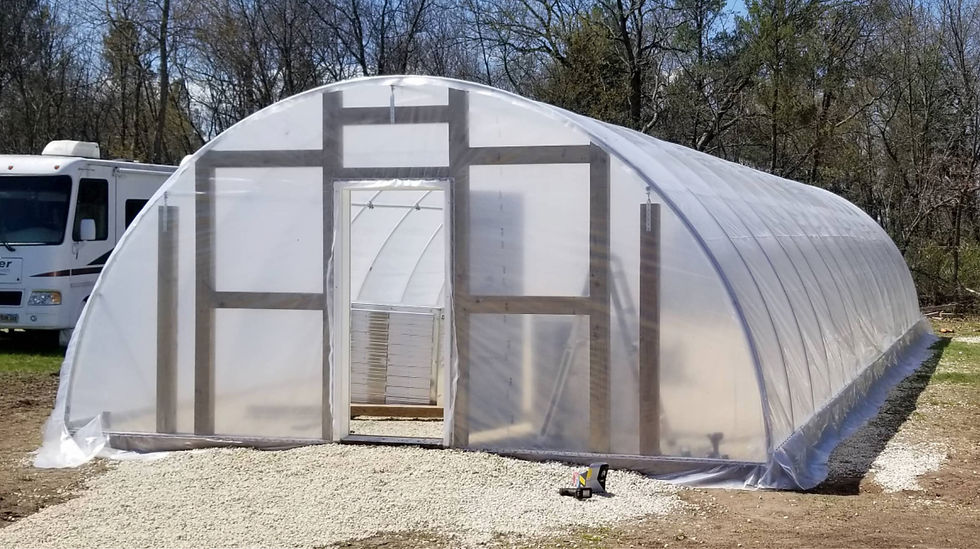
A high tunnel (sometimes called a hoop house, though the terms aren't perfectly interchangeable either) is a simpler, more flexible structure. It's built from metal hoops or arches covered in polyethylene film, anchored directly into the ground without a permanent foundation, and relies on passive ventilation — roll-up sides and open end walls — rather than active climate control systems. The USDA's NRCS program, which has funded thousands of high tunnels across the country, defines a high tunnel specifically as a structure where crops are grown directly in the ground rather than in containers or raised beds.
High tunnels are designed to extend the season, not necessarily to replace outdoor growing conditions entirely. They protect crops from frost, wind, and weather extremes, and they do it at a fraction of the cost of a traditional greenhouse.
Where It Gets Confusing
Here's where the terminology starts to fall apart a little: in the real world, most growers use these terms based on what they're trying to accomplish rather than strict construction definitions. And a lot of modern growing structures — including the ones we manufacture — don't fit neatly into either traditional category.
Our steel-frame, poly-covered kits are built to be far more durable and long-lasting than a traditional hoop house, with galvanized steel frames and UV-rated greenhouse film rated for four-plus years. But they don't have a concrete foundation or a built-in HVAC system. So are they high tunnels or greenhouses? The honest answer is: they're both, depending on how you set them up and what you're growing.
Add roll-up sides and an exhaust system and you have excellent passive ventilation for summer growing. Add a thermostat and a heat source and you have year-round climate control. The structure itself is the same — what changes is how you equip and use it.
What Actually Matters When You're Deciding
Rather than getting too hung up on terminology, here's what I'd actually think about when you're trying to figure out what you need:
What are you growing? Cool-season crops like spinach, kale, lettuce, and greens don't need active heat management in most climates — they just need frost protection and a bit of season extension on either end. A well-built high tunnel handles this beautifully. Warm-season crops like tomatoes and peppers need warmer, more consistent conditions, which might mean adding some heat retention strategies or supplemental heat.

What's your climate? A grower in the Southeast with mild winters has very different needs than someone in Minnesota or Canada who needs a structure that can hold heat through months of sub-zero nights. The structure itself matters, but so does how you equip it.
How long do you plan to use it? A temporary season-extension setup calls for different priorities than a structure you plan to grow in year-round for the next 20 years. If you're making a long-term investment, the quality of the frame and the durability of the covering matter a lot.
Are you growing in-ground or in containers? Traditional high tunnels are optimized for in-ground growing, which gives you access to the soil's natural thermal mass and moisture retention. If you want to grow in raised beds or on benches, a wider, taller structure gives you more flexibility.
What We Build and Why
Our kits are designed to serve as both — a serious, long-term structure that starts as a high tunnel and can be built up into a more fully controlled growing environment as your needs grow. We manufacture our frames from American-made galvanized steel in-house in Ozark, Missouri, which gives us control over quality that you don't get with imported steel frames.
The result is a structure that holds up to the kind of weather most growers actually face — heavy snow loads, summer heat, high winds — without the cost or permanence of a traditional greenhouse foundation. And because our kits are modular, you can add roll-up sides, exhaust systems, shade cloth, and other components as your operation grows.
Whether you're a hobby grower looking to extend your season by a few months or a commercial producer who needs year-round production capability, there's a configuration that works. Browse our All Inclusive Packages to see how we bundle everything together, or give us a call and we'll help you figure out exactly what makes sense for your goals.

The Short Answer
If someone asks whether our kits are high tunnels or greenhouses, the honest answer is that they're built to function as both. The traditional definitions are useful for understanding the spectrum of what's available, but what actually matters is whether the structure you choose does what you need it to do, is built to last, and fits your budget.
If you're not sure which configuration is right for your growing goals, give us a call. That's exactly the kind of conversation we have every day, and we'd rather help you get it right from the start than have you buy something that doesn't fit what you're trying to accomplish.
Happy growing!
Comments